Opti-Flow AI Agent: Real-Time Dynamic Warehouse Spatial Optimization & Multi-Agent Simulation
We are thrilled to announce that our team, AutoRoute Agents, was selected as one of the top 20 finalists out of 350 teams who registered for the NVIDIA - GSI Hackathon. It was an absolute privilege to present our solution, Opti-Flow AI Agent, live at the NVIDIA India headquarters in Bangalore.
The Challenge
In automated high-throughput warehouses, unexpected disruptions are daily occurrences:
- Sudden priority rushes requiring immediate reordering of pick tasks.
- Blocked aisles due to spills, equipment malfunctions, or physical obstacles.
- Heuristic route algorithms operating as opaque black boxes that leave operators unable to review or verify path validity before triggering robots.
- High-latency recalculations causing idling fleets and warehouse gridlock.
The Goal
Empower warehouse operators to dynamically adapt to disruptions in real time by:
- Evaluating pick capacities and dynamically shifting vehicle schedules on the fly.
- Handling priority shifts interactively with natural language commands.
- Verifying 3D route changes across intuitive digital layouts before pushing to physical execution.
- Running end-to-end physics validation in simulation to prevent real-world robot collisions.
Two-Tier Architecture & NVIDIA Tech Stack
In just three weeks, we conceptualized and built two powerful tools to address real-world challenges, combining browser spatial telemetry with high-fidelity physics simulation and GPU-accelerated microservices:
Tier 1: Lightweight React + Three.js UI
Provides immediate operator visualization on any web browser. Supervisors view real-time 3D warehouse layouts, trigger synthetic obstacle simulations (e.g., closing Aisle A3-S), inspect graph-based routing paths, and review proposals with a human-in-the-loop review mechanism.
Tier 2: Omniverse Extension & Isaac Sim
A custom NVIDIA Omniverse Extension driving Isaac Sim for high-fidelity physics validation. Stages photorealistic USD warehouse environments and simulates robotic Autonomous Mobile Robots (Clearpath Ridgeback Franka AMR), validating collision-free navigation and payload constraints.
NVIDIA cuOpt Microservice
GPU-accelerated routing optimization microservice running on cluster port 8000. Resolves complex warehouse picking routes, multi-picker capacity schedules, and vehicle stop orders in sub-second intervals, replacing slow traditional CPU solvers.
NVIDIA NIM & Nemotron 3 Nano Omni
Interprets natural language supervisor planning requests into structured JSON tool calls (get_warehouse_state, propose_picking_plan). Ensures the agent cannot approve or dispatch orders without human-in-the-loop operator confirmation.
Local Deployment on NVIDIA B300 GPU Cluster
Both the NVIDIA cuOpt microservice and the Nemotron 3 Nano Omni models ran entirely locally on the high-performance NVIDIA B300 GPU cluster provided by the organizers, delivering near-instantaneous replanning, ultra-low latency spatial inference, and smooth multi-agent orchestration.
The Core Takeaway
“Effective industrial AI isn't simply about solving an optimization algorithm in a black box. It's about bridging mathematical precision with spatial clarity — giving operators interactive, explainable, and human-in-the-loop control over complex automated environments.”
Photo & Architecture Gallery
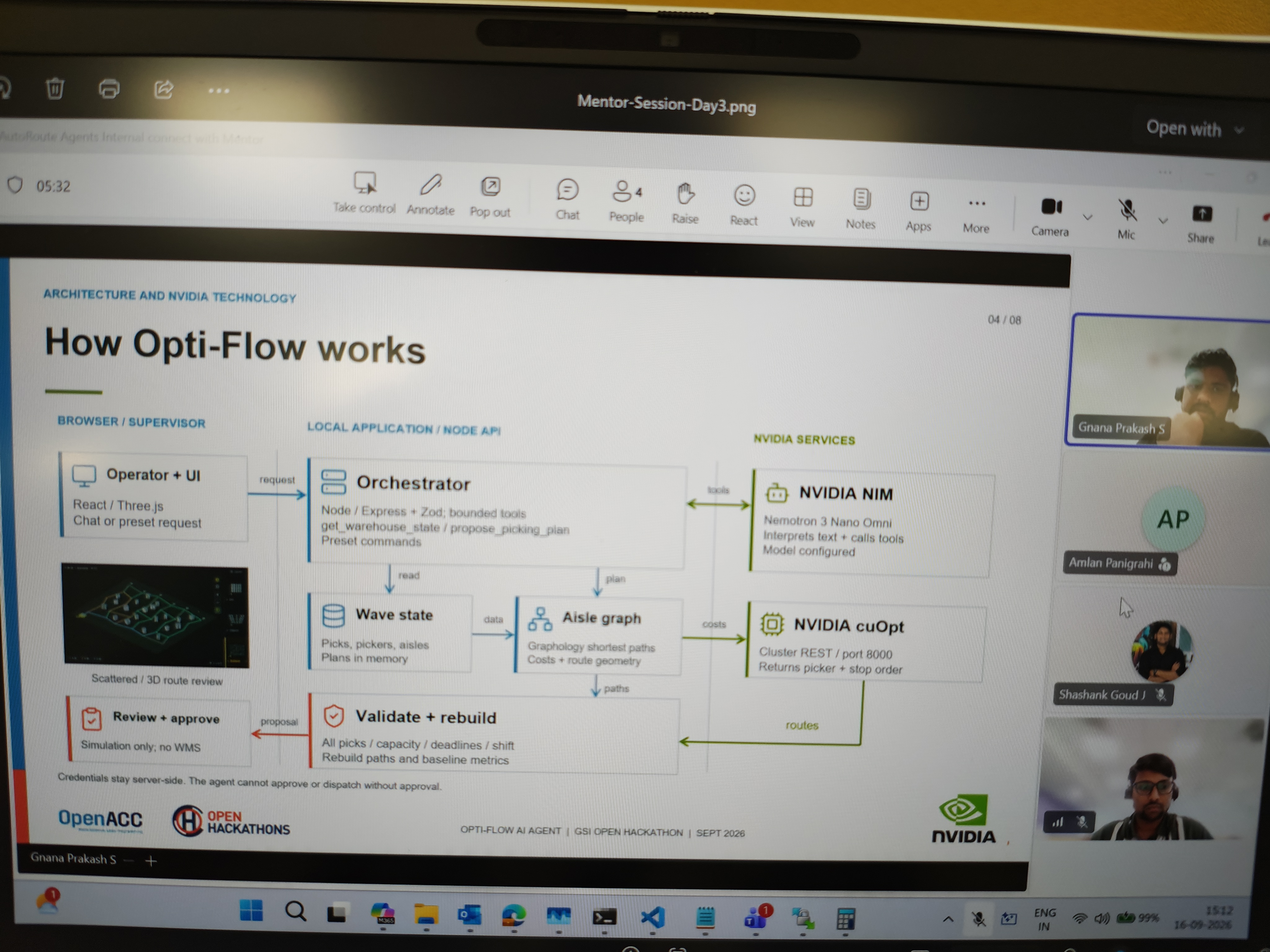
Complete System Architecture
Supervisor UI (React/Three.js) → Orchestrator (Node API) → NVIDIA NIM (Nemotron 3 Nano) → NVIDIA cuOpt solver.
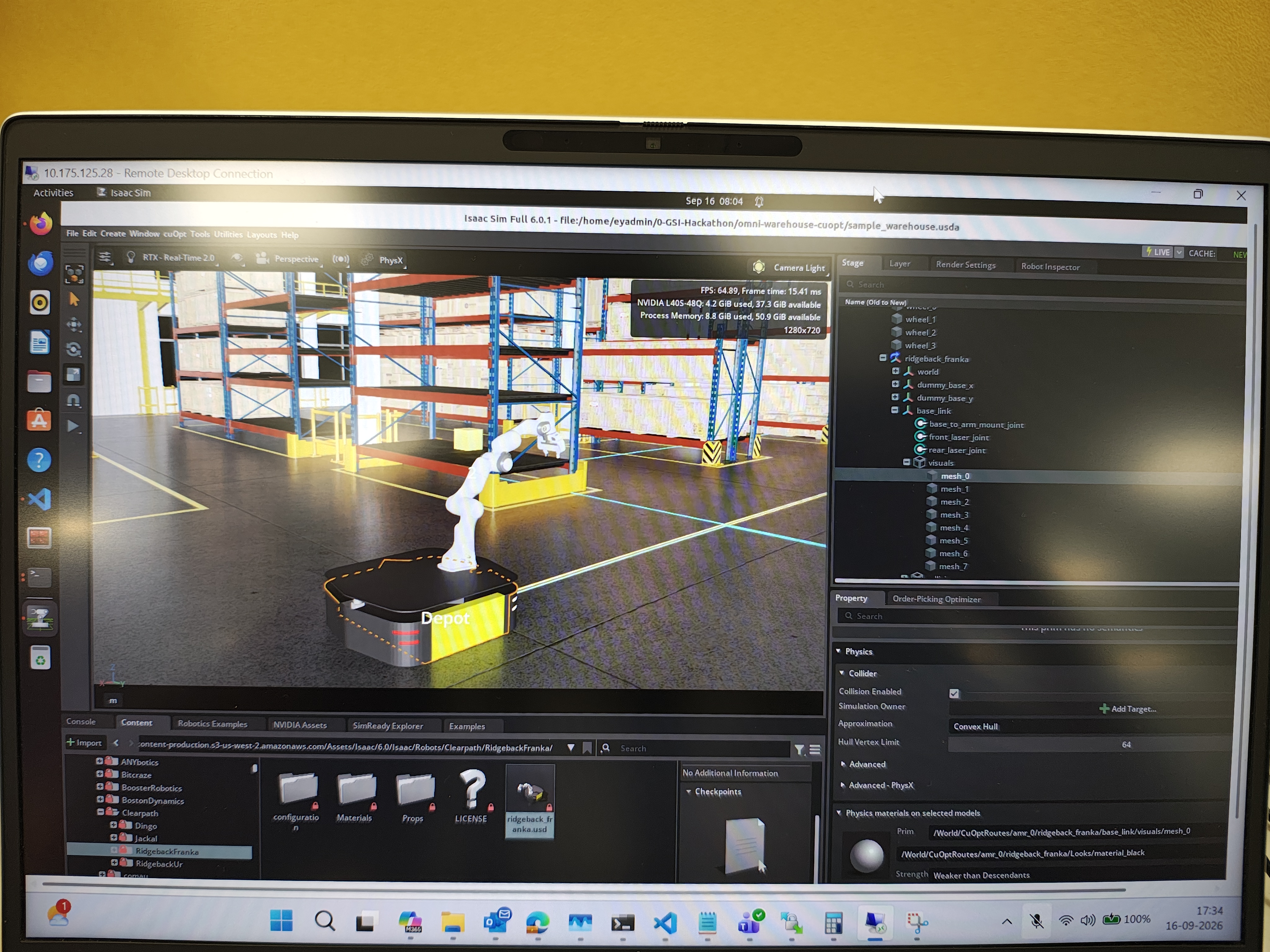
Isaac Sim Robotics Digital Twin
Real-time USD physics simulation in Isaac Sim 6.0.1 driving Clearpath Ridgeback Franka robot through cuOpt routes.
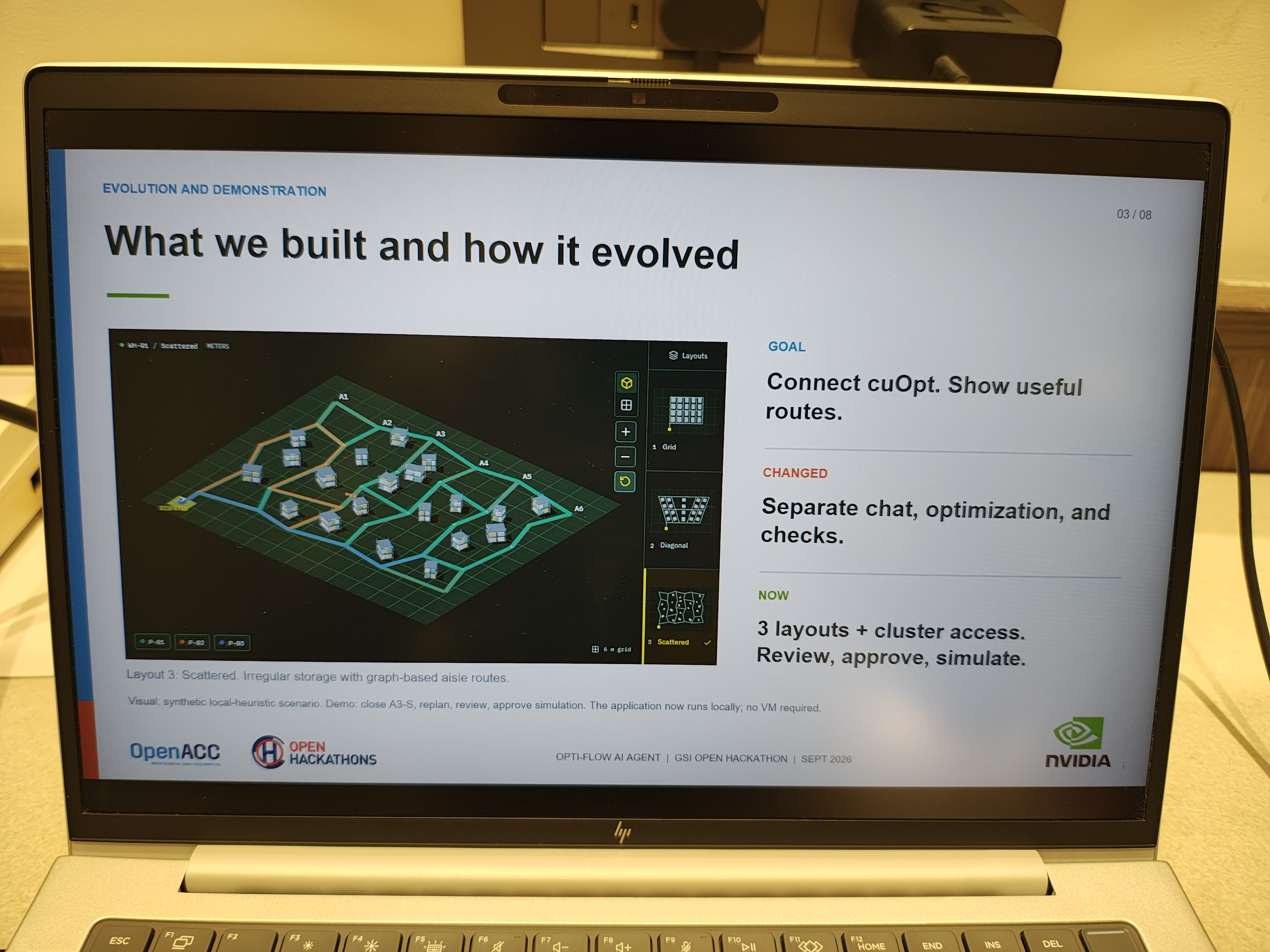
3D Warehouse Layout & Route Evolution
Interactive 3D graph-based aisle routing, synthetic scenario generator, and real-time replanning review.
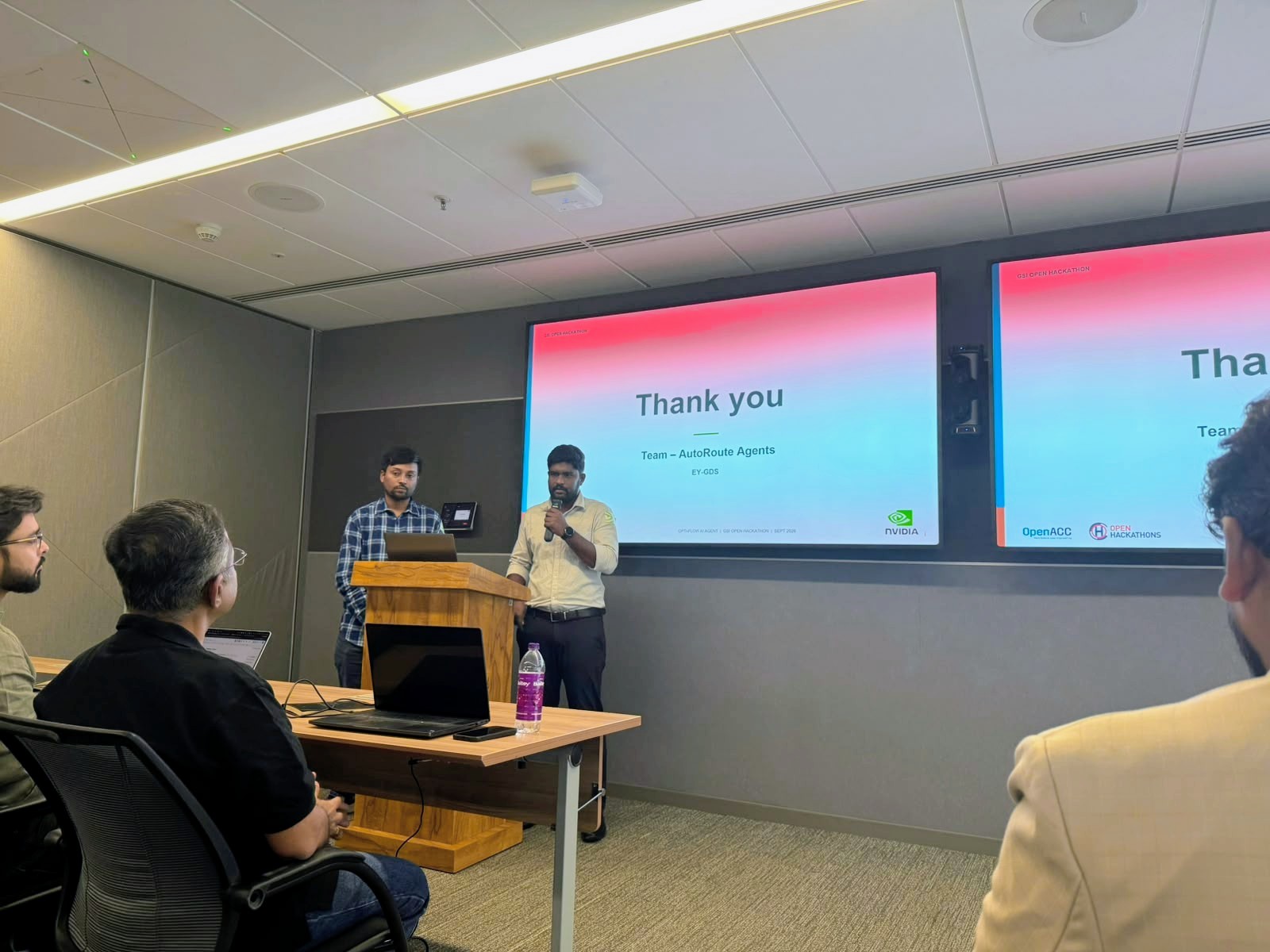
Live Stage Presentation at NVIDIA HQ
G Bhanuteja & teammate presenting live at NVIDIA India headquarters in Bangalore before judges and organizers.
Mentorship, Collaboration & Acknowledgements
We could not have accomplished this without the guidance and support of our incredible mentor, Amlan Panigrahi. A big thank you for your invaluable inputs throughout the development process.
We would also like to extend our deepest gratitude to the esteemed judges Sundar R Nagalingam and Saurav Agarwal for their insightful feedback, as well as the GSI Hackathon organizers, Apoorva Laharia, Ganesh Sai Apuroop Koppaka, and Bharatkumar Sharma. We are inspired by your suggestions and are excited to explore integrating the remaining features that time didn't allow during the competition.
A huge shoutout to my fantastic teammates: Gnana Prakash S, Shashank Goud J, and Alagappan for the tireless collaboration over the past 3 weeks.
Finally, a massive thank you to the EY Leadership team for enabling this amazing opportunity and supporting our participation: Srinivasagopalan Venkataraman, Shyama Hariharan, Indraneel Ghosh, and Pranav Buradkar.